

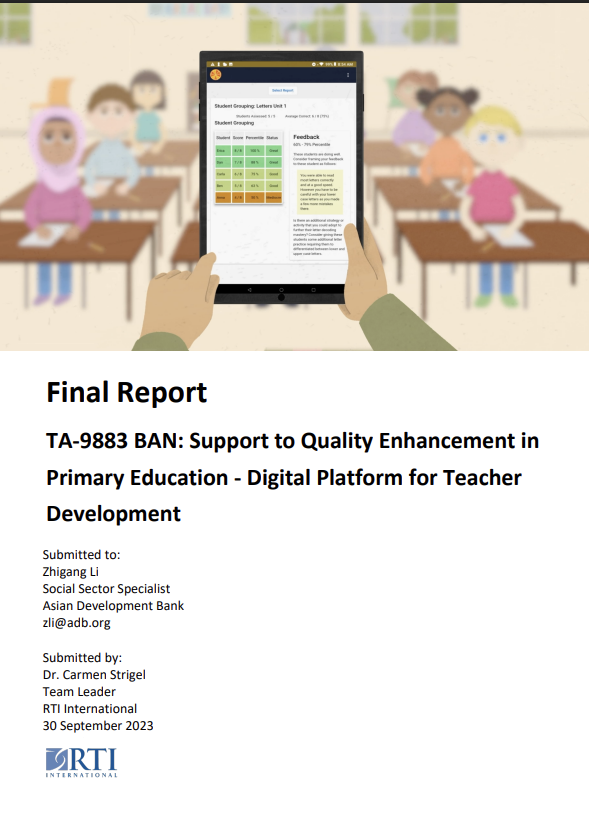
Report: Bangladesh Digital Platform for Teacher Development
This document presents the Final Report for the Digital Platform for Teacher Development Technical Assistance (TA) funded by Asian Development Bank (ADB) Bangladesh and implemented by RTI International (RTI).
A Phase 1 proof of concept implementation in 2021 in ten schools in Bangladesh confirmed viability of the use of the platform in the context. In Phase 2, running from March-December 2022, the initiative was piloted in 110 new schools in 26 Upazillas of Bangladesh and revised in preparation for scale up to 1,000 schools next. The TA included modest preparatory support to the Bangladesh Directorate of Primary Education (DPE) for scaling the initiative to an estimated 1,000 schools under their own leadership in late 2023. The TA for this phase started in November 2022 and ended in September 2023. This report is an overview of all completed activities and results and presents challenges in the implementation of the TA as well as recommendations for DPE’s scale up of the platform to 1,000 schools and beyond.
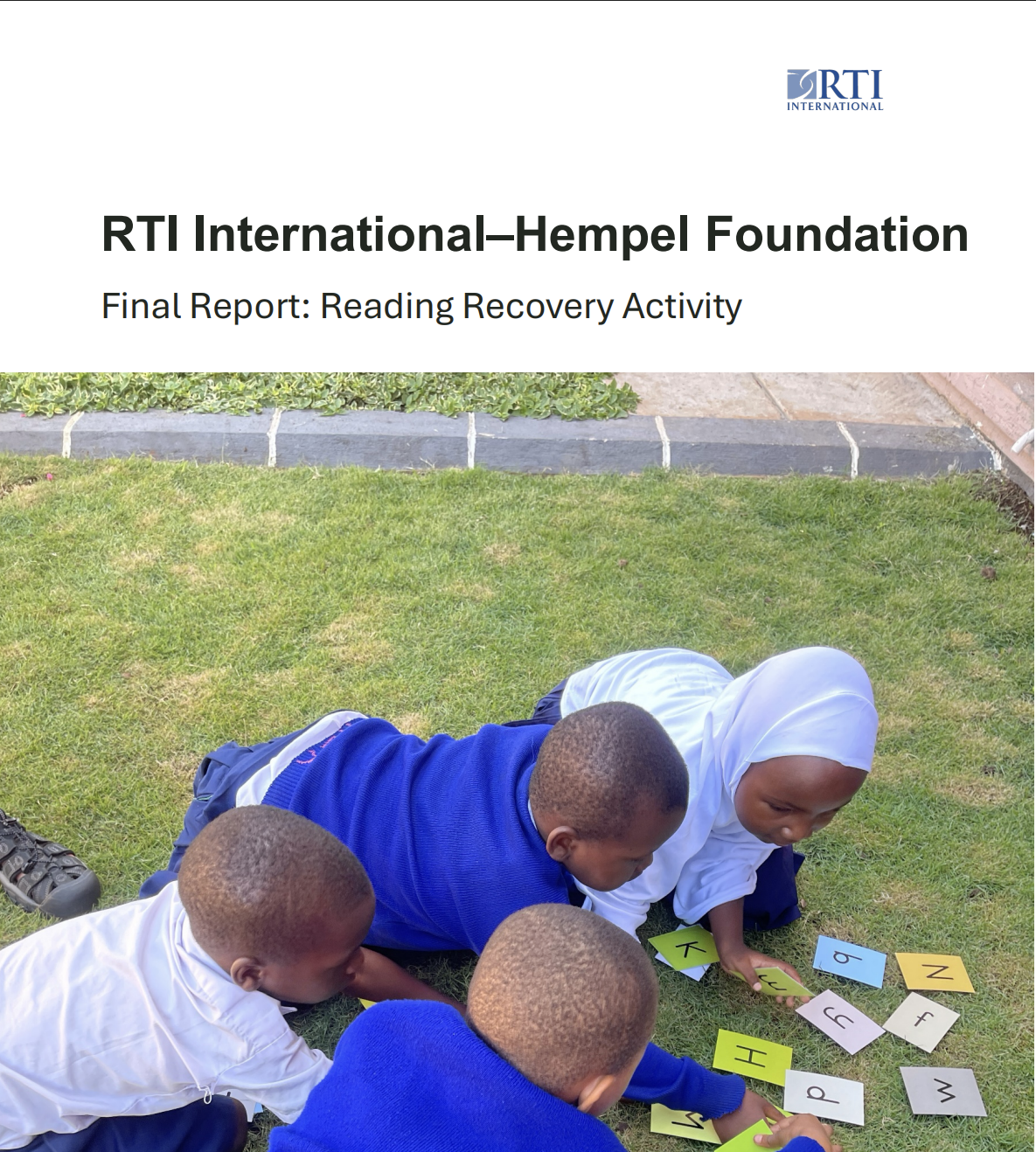
Report: Tanzania Reading Recovery Activity
The Reading Recovery Activity strengthened early grade reading proficiency through structured remedial instruction in Tanzania. Funded by the Hempel Foundation, the Activity was implemented from 2023 through 2025 by RTI International in partnership with the Government of Tanzania, including the Ministry of Education, Science and Technology (MoEST), the Prime Minister’s Office Regional Administration and Local Government (PMO-RALG), and regional governments.
Report: Let's Read — How Tusome Leveraged EdTech to Improve National Learning Outcomes
The case study discussed in this brief, Tusome in Kenya, presents an example of how technology should serve and not guide national reform programmes. What the Tusome programme and others like it illustrate is that there are many other factors at play. Trust, capacity, and accountability are some but not all of the considerations that can make the difference between adoption or abandonment of an EdTech intervention.
Article: Does technology improve reading outcomes?
A randomized controlled trial in Kenya examined whether adding technology to a proven literacy program improves early reading outcomes. Three interventions were tested: tablets for instructional supervisors, tablets for teachers, and pupil e-readers. All groups showed significant gains over the control, but none outperformed the base non-ICT program by a meaningful margin. Cost-effectiveness analysis revealed that supervisor tablets equipped with Tangerine:Coach, delivered the best value, while pupil e-readers were the least cost-effective. The study underscores that technology should complement—not replace—strong instructional programs and that cost considerations are critical for scaling ICT in education.
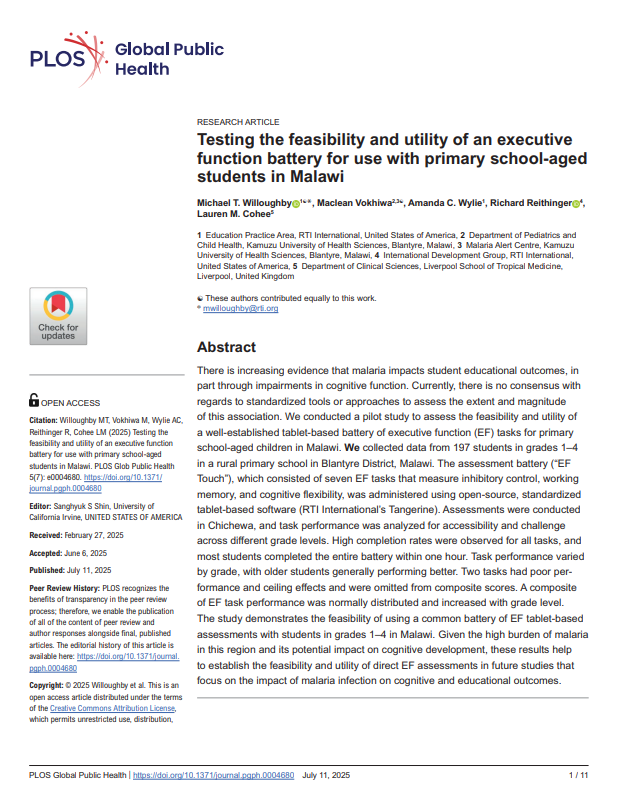
Article: Feasibility and utility of EF:Touch
Researchers piloted Tangerine’s tablet-based executive function (EF) assessments with 197 students in rural Malawi, replacing older laptop-based methods with a more accessible, tablet format. Nearly all children completed the tasks in under an hour, demonstrating that tablets can deliver reliable cognitive measures even in low-resource schools. This innovation opens the door for large-scale studies on how malaria affects learning and supports evidence-driven strategies to improve education in high-burden regions. By making advanced cognitive assessments portable and practical, Tangerine is helping bridge health and education for lasting impact.
Report: Data collection and visualization tools in the education sector
In this report, the authors explore digital tools that allow for cost-effective, adaptable, usable, timely, and reliable data collection and visualization to inform decision-making. To develop this resource, a market landscape analysis was developed to identify potential tools. From over 50 tools, four (including Tangerine) were explored in depth to understand how they were used and adapted to different contexts in sub-Saharan Africa and South Asia. These case studies help users to understand the adaptability of the tools for different research needs and highlight the challenges in those implementations.
Report: Tanzania Kiswahili Self-Administered EGRA/EGMA Pilot Results
This report summarizes the findings of an effort to develop and validate a tablet-based, self-administered assessment of Kiswahili-language foundational literacy and numeracy in the early grades in Tanzania.
Report: Malawi Chichewa Self-Administered EGRA/EGMA Pilot Results
This report summarizes the findings of an effort to develop and validate tablet-based, self-administered early grade reading and math assessments (SA-EGRMA) for Chichewa-language foundational literacy and numeracy in the early grades in Malawi.
Report: Ghana English Self-Administered EGRA and EGMA Pilot Results
This report summarizes the findings of an effort to develop and validate tablet-based, self-administered assessments of English-language foundational literacy and numeracy in the early grades. The tools described in the report were developed at the request of Imagine Worldwide with the support of the Jacobs Foundation. RTI carried out field testing and a pilot study to assess the tools' internal consistency, test-retest reliability, and concurrent validity with respect to "traditional" EGRA and EGMA. RTI International developed the two assessments, known respectively as the Self-Administered Early Grade Reading Assessment (SA-EGRA) and the Self-Administered Early Grade Mathematics Assessment (SA-EGMA), with the support and at the direction of Imagine Worldwide. The assessments are deemed “self-administered,” because children complete the assessments independently in response to instructions and stimuli imbedded in the tablet-based software. However, adults typically supervise the organization and conduct of the assessment as well as the collection of individual data from the tablets for analysis.
Report: Ghana English Self-Administered EGRA and EGMA Pilot Results (Additional Analyses)
RTI International conducted additional analyses of Ghana’s pilot of tablet-based, self-administered Early Grade Reading (SA-EGRA) and Mathematics (SA-EGMA) assessments. Findings confirm strong reliability for most tasks and highlight the Spelling subtask as a robust proxy for oral reading fluency, even when compared to a composite literacy score built using Structural Equation Modeling (SEM). Syntax redesign successfully eliminated “yes bias,” while some numeracy tasks, like Number Identification, performed less effectively with higher-proficiency students, suggesting item adjustments for advanced learners. These insights strengthen the case for scalable, child-driven assessments using Tangerine, enabling accurate, efficient measurement of foundational skills in low-resource contexts.